
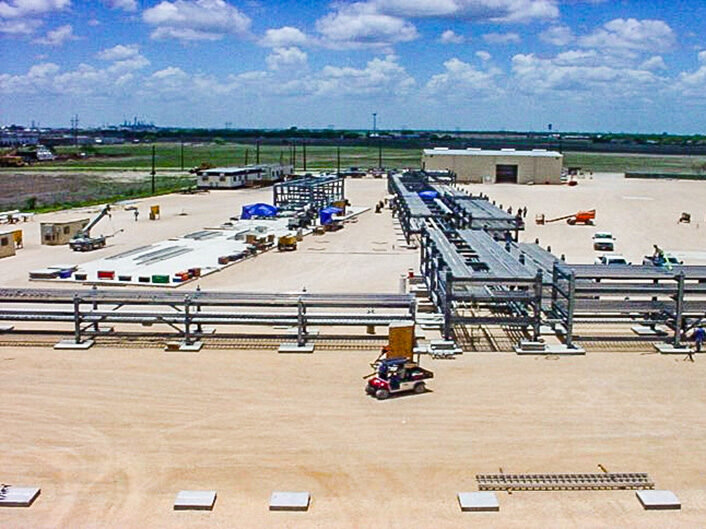
Corpus Christi has become the nation’s leading energy export gateway. The Port of Corpus Christi handles more U.S. crude oil exports than any other port in the country, moving over 2 million barrels per day and holding roughly 60% of the national crude export market. It ranks as the third-largest port in the country by total waterborne tonnage, and the newly deepened Corpus Christi Ship Channel, now 54 feet deep and 530 feet wide, can fully load Suezmax tankers and handle VLCCs for the first time in the port’s history. Add in Cheniere’s Corpus Christi Liquefaction facility, on track to reach more than 25 mtpa of LNG capacity, and six refineries including CITGO and Valero, and you get an industrial corridor punching well above its population.
That scale creates enormous opportunity, and it also creates enormous risk. A shutdown, expansion, or new construction project along the Coastal Bend doesn’t fail because the lead engineer made a bad call on paper. It fails in the details: a weld that doesn’t hold, a tank that gets flagged during an inspection nobody scheduled for, a turnaround that blows past its window because the wrong specialist wasn’t in the room early enough.
Add one more wrinkle to the mix. South Texas’s industrial sector is now competing with Gulf Coast data center and AI power campus projects for the same welders, pipefitters, and instrument technicians that refineries and LNG terminals have relied on for decades, and nearly half of the current skilled trades workforce is over 45 years old. Lining up the right specialists early has become a competitive advantage rather than a nice-to-have, especially with Cheniere’s Stage 3 expansion, the Stage 4 project moving through FERC review, and CCL Midscale Trains 8 and 9 all competing for the same labor pool at once.
Here are the nine engineering specialties every Corpus Christi industrial project should have on the team.
1. Tank Engineers Who Understand API 650 and API 653 Compliance
Why they matter: Not every mechanical engineer is qualified to work on aboveground storage tanks. Facilities handling crude oil, refined products, and LNG-adjacent liquids need engineers fluent in API 650, the design standard for new tanks, and API 653, the standard that governs every tank already in service. With Corpus Christi’s tank farms expanding to keep pace with rising crude export volumes and LNG feed gas storage, this expertise is in short supply exactly when it’s needed most.
What the code requires:
- External inspections at least every five years
- Internal inspections within ten years of construction, then every ten to twenty years depending on corrosion rate and contents
- Ultrasonic thickness testing at least every five years, tightening to annual or semiannual checks once corrosion exceeds 0.05 inches per year
A tank engineer who understands this framework builds a maintenance and capital plan around it instead of reacting to a failed inspection after the fact, evaluating shell integrity, roof systems, settlement patterns, and corrosion allowances well before they become compliance problems.
2. Certified Welding Engineers Who Prevent Expensive Rework
Why they matter: A single rejected weld can delay an entire construction schedule, and on a Coastal Bend turnaround or LNG train commissioning where every day of downtime carries real cost, that delay compounds fast. Certified Welding Engineers, known industry-wide as CWEs, develop welding procedure specifications, qualify welders, and confirm every joint meets ASME Section IX and AWS code requirements before it gets buried under insulation or bolted into a process line.
Where their value shows up:
- Fewer field repairs once equipment reaches service
- Welding procedures qualified correctly the first time
- Clear visibility into exactly which qualifications a contractor’s welding crew needs to carry
With Cheniere’s remaining Stage 3 trains and the Stage 4 project both drawing on the same regional welding workforce, a CWE also plays a quiet role in staffing strategy by matching the right qualifications to the right job instead of overbidding on labor a project doesn’t need.
3. Turnaround Project Managers Who Thrive Under Tight Deadlines
Why they matter: Plant turnarounds compress months of maintenance work into a matter of weeks, sometimes days. With crack spreads running strong through 2026 and export demand pulling hard on Coastal Bend refining capacity, operators have every financial incentive to keep units running as long as the steel allows, which pushes turnaround windows even tighter as deferred maintenance scope keeps growing.
What sets them apart from a typical construction PM:
- Coordinating hundreds of contractors, equipment deliveries, inspections, and permits at once
- Sequencing critical-path work so a delay on one unit doesn’t cascade into missed windows on three others
- Treating every hour of downtime as a direct production loss, not just a scheduling inconvenience
Their experience running that high-stakes choreography can meaningfully reduce schedule overruns during a maintenance outage, particularly at a refinery running near capacity to keep up with export demand.
4. Pressure Vessel Specialists Who Know More Than the Code Book
Why they matter: Pressure vessel engineering involves far more than sizing equipment to a spec sheet. Specialists in this discipline evaluate fatigue life, corrosion allowances, nozzle loads, thermal expansion, and inspection access, and they think about all of it in the context of how the vessel will be maintained ten or twenty years down the road.
The mistake they catch early: a vessel designed without adequate inspection access can turn a routine API 510 inspection into a scaffolding and confined-space nightmare that costs far more than the original design shortcut ever saved. This forward-looking evaluation helps facilities avoid expensive modifications years after installation, which matters even more as Coastal Bend refineries and LNG process units run harder and longer to meet growing export demand.
5. Welding Inspectors Who Catch Problems Before They Reach the Field
Why they matter: Certified Welding Inspectors, or CWIs, sit at a critical junction between engineering and construction. They verify weld quality against the approved procedure, review documentation for completeness, and witness the destructive and nondestructive testing that confirms a weld meets code.
The layered defense they create:
- Ultrasonic, radiographic, magnetic particle, and dye penetrant examinations coordinated on-site
- A second set of trained eyes independent of the fabrication shop
- Documentation that holds up during owner and regulatory audits
Catching a defect in the fabrication shop is almost always cheaper than repairing it after the equipment is already installed, and that cost gap only widens once a unit is running, especially on LNG-grade piping and vessels where the tolerances leave little room for error.
6. Structural Engineers for Heavy Industrial Equipment
Why they matter: Supporting process equipment requires a different skill set than designing commercial buildings. Industrial structural engineers calculate loads from vessels, piping, rotating equipment, cranes, and elevated platforms, while accounting for vibration, thermal movement, and maintenance access that a typical commercial structure never has to consider.
Coastal Bend-specific factors they design around:
- Hurricane wind loads off the Gulf of Mexico
- Settlement risk from the region’s soft coastal soils along Corpus Christi Bay and the La Quinta Ship Channel
- Load interaction across densely packed refinery, tank farm, and LNG infrastructure clustered around the Inner Harbor and San Patricio County
This density, combined with direct Gulf exposure, is part of what makes structural work here different from inland industrial markets.
7. Mechanical Integrity Engineers Focused on Aging Infrastructure
Why they matter: Several Coastal Bend refineries have equipment that’s been operating for decades, running harder now that crude export demand keeps them near full capacity. Mechanical integrity engineers evaluate remaining asset life, corrosion rates, inspection histories, and repair priorities to help owners extend equipment life without compromising safety or reliability.
Why this role has become more urgent:
- Aging refinery assets are colliding with tighter turnaround windows
- The pool of experienced fixed equipment specialists is shrinking
- Risk-based inspection frameworks now decide where limited turnaround hours go
A mechanical integrity engineer makes sure a facility spends its inspection budget on the equipment that needs it, rather than spreading resources evenly across assets with very different risk profiles.
8. Fabrication Engineers Who Bridge Design and Manufacturing
Why they matter: Even a flawless design can run into production challenges once it reaches the shop floor. Fabrication engineers optimize drawings for manufacturability, improve weld sequencing to reduce distortion, coordinate material procurement, and work closely with shop personnel to keep projects moving efficiently from engineering release through fabrication.
Why this role carries more weight in 2026: Corpus Christi’s fabrication shops are competing for the same skilled welders and fitters being pulled toward LNG train construction and Gulf Coast power infrastructure projects. A fabrication engineer who designs for the workforce available, rather than the workforce a project assumed it would have, is often the difference between a fabrication schedule that holds and one that slips by months.
9. Field Engineers Who Solve Problems in Real Time
Why they matter: Construction rarely goes exactly as planned. Field engineers address unforeseen site conditions, verify measurements against as-built conditions, coordinate design revisions with the engineering office, and make sure installations match engineering intent even when the field doesn’t match the drawings.
What their judgment is worth: their ability to make fast, informed decisions, often standing at the base of a vessel with a contractor waiting on an answer, keeps projects on schedule in a way a remote design team can’t replicate. On a Coastal Bend turnaround or LNG commissioning push where idle craft labor costs money by the hour, a field engineer’s real-time calls carry a direct dollar value.
Why Workforce Shortages Make Early Planning Non-Negotiable
South Texas’s industrial sector is navigating a labor market unlike anything it’s seen in recent memory, right as Corpus Christi’s export infrastructure enters its biggest growth cycle in decades.
The numbers behind the crunch:
- Roughly 48% of the current skilled trades and engineering workforce is over 45
- Retirements are outpacing new entrants across welding, pipefitting, instrumentation, and mechanical integrity roles
- Cheniere’s remaining Stage 3 trains, the Stage 4 project, and Midscale Trains 8 and 9 are all drawing on the same regional labor pool as the port’s refineries and terminal operators
Facilities that build relationships with qualified CWEs, tank engineers, and mechanical integrity specialists well ahead of a planned turnaround or expansion are the ones that keep their schedules intact when the broader labor market tightens. Waiting until a project is already underway to fill these roles now carries a real risk of delay that simply didn’t exist a decade ago, and that risk only grows as more LNG capacity comes online along the Coastal Bend.
Why These Specialized Roles Matter
Industrial projects in Corpus Christi operate under strict safety standards, aggressive schedules, and significant financial investment, all layered on top of a regional labor market that’s tighter than it’s been in years. Bringing specialized engineering expertise into a project early can reduce change orders, improve quality, minimize downtime, and help facilities meet regulatory requirements from the EPA, OSHA, and API all at once.
Whether you’re constructing a new tank farm, upgrading refinery equipment, or completing a major plant turnaround, success along the Coastal Bend often depends on the professionals working behind the scenes and not just the engineers whose names appear on the drawings.


